Arresting a Vessel from Bombay High Court
The Bombay High Court, an eminent institution in the Indian legal landscape, has long been vested with the authority to exercise admiralty jurisdiction. This jurisdiction has been further codified and expanded by the Admiralty (Jurisdiction and Settlement of Maritime Claims) Act, 2017 (hereinafter referred to as the "Act"), which consolidated various aspects of maritime law, including the arrest of ships, to align with international standards. The provisions of the Act delineate the scope and procedures governing the arrest of ships within Indian territorial waters, particularly within the jurisdiction of the Bombay High Court. The arrest of ships under this jurisdiction serves as an important tool to secure maritime claims, offering a remedy to claimants seeking satisfaction for their grievances.
1. Admiralty Jurisdiction of the Bombay High Court
Historically, the Bombay High Court has been vested with admiralty jurisdiction over maritime matters in India. The jurisdiction is now governed by the Admiralty (Jurisdiction and Settlement of Maritime Claims) Act, 2017, which has codified the court's authority and clarified its role in adjudicating maritime claims, including the arrest of vessels. Section 3 of the Act enumerates the High Courts at Bombay, Calcutta, Madras, Gujarat, Hyderabad, Telangana, Kerala, Andhra Pradesh, Odisha, and Karnataka as the courts with exclusive admiralty jurisdiction. Specifically, Section 4 empowers the Bombay High Court to entertain and adjudicate upon maritime claims, including actions in rem for the arrest of a vessel, provided that the vessel is situated within the territorial waters of Maharashtra at the time of the arrest.
2. Territorial Waters and Jurisdictional Reach
The jurisdiction of the Bombay High Court extends across the vast territorial waters of Maharashtra, encompassing a coastline of over 720 kilometers. This extensive coastline includes notable maritime regions, such as the Greater Mumbai District (approximately 114 kilometers), Thane District (127 kilometers), Raigad District (122 kilometers), Ratnagiri District (237 kilometers), and Sindhudurg District (120 kilometers). The region is further enriched by the presence of numerous ports, including 48 intermediate and minor ports and 35 creeks, all of which contribute to significant maritime activity. Consequently, the Bombay High Courts admiralty jurisdiction covers a broad geographical area, making it an important center for resolving maritime disputes and enforcing maritime claims.
3. Filing an Admiralty Suit for Arrest
The process of arresting a vessel under the Bombay High Courts admiralty jurisdiction commences with the filing of an admiralty suit. This process is governed by the provisions of the Act and any relevant international conventions to which India is a party. Section 4 of the Act outlines the types of maritime claims that may give rise to an action in rem, including but not limited to:
-
Ownership or possession disputes concerning ships;
-
Claims arising from damages or losses caused by the operation of a vessel;
-
Claims related to unpaid wages of the crew;
-
Disputes regarding the carriage of goods or passengers;
-
Claims for necessaries or supplies provided to the vessel.
To initiate an arrest, the claimant must establish that their claim falls within the scope of the Act, and that the vessel sought to be arrested is situated within the jurisdiction of the Bombay High Court at the time the arrest warrant is issued.
4. Grounds for Arrest of a Vessel
The arrest of a vessel is a prejudgment remedy, used to secure the satisfaction of a maritime claim before the underlying dispute is resolved. It is essential that the claimant demonstrates a prima facie case for arrest and provides sufficient evidence to support the claim. The following elements must be satisfied:
-
Prima Facie Case: The claimant must establish that their claim is legitimate and that there is a reasonable likelihood that the claim will succeed.
-
Vessel Within Jurisdiction: The vessel sought to be arrested must be physically located within the territorial waters of Maharashtra at the time of the arrest. This can be substantiated by affidavits from marine surveyors or port authorities.
Additionally, the claimant must show that the claim falls within the categories outlined in Section 4 of the Act. Failure to demonstrate a valid claim or to provide evidence of the vessels location may result in the denial of the arrest application.
5. Procedural Requirements for Filing an Admiralty Suit
The process of filing an admiralty suit and seeking the arrest of a vessel involves several crucial steps:
A. Preparation of the Plaint
The claimant must draft a comprehensive Plaint that sets out the nature of the maritime claim, the facts leading to the cause of action, and the specific relief sought, including the arrest of the vessel. The Plaint should also identify the defendant and the vessel to be arrested.
B. Verification and Affidavits
The Plaint must be accompanied by an affidavit verifying the factual allegations made in the Plaint. The affidavit must disclose all material facts, including the claimant's prior efforts, if any, to resolve the dispute. Additionally, the claimant must disclose any prior proceedings against the vessel or its owners, as such prior actions may have a bearing on the current suit.
C. Jurisdictional Compliance
The claimant must provide evidence that the vessel is within the territorial jurisdiction of the Bombay High Court. This can be done through affidavits from marine surveyors or port authorities or by presenting shipping documents indicating the vessel's location at the time the suit is filed.
D. Security
In certain cases, the Bombay High Court may require the claimant to provide counter-security to indemnify the vessel owner in the event that the arrest is found to be wrongful. This security is typically in the form of a bank guarantee or cash deposit, ensuring that the vessel owners interests are protected during the arrest process.
6. Execution of the Arrest
Once the procedural requirements have been met and the court is satisfied with the claim, the Bombay High Court will issue a Warrant of Arrest. This warrant directs the Sheriff of Mumbai or the Port Officer of the respective jurisdiction to carry out the arrest. Upon receipt of the warrant, the designated officer will serve it on the Master or Agent of the vessel and inform the relevant port authorities. The arresting officer will then ensure that the vessel is immobilized, preventing its departure from the jurisdiction of the Bombay High Court.
7. Groups of Ports Under Maharashtras Coastline
The coastline of Maharashtra is divided into several administrative port groups, each under the authority of a Port Officer. The major groups include:
-
Bandra Group of Ports: Including Dahanu, Tarapur, Navapur, and others.
-
Mora Group of Ports: Comprising Trombay, Mahul, Panvel, and other ports.
-
Rajpuri Group of Ports: Including Thal, Alibag, and others.
-
Ratnagiri Group of Ports: Comprising Bankot, Kelshi, Dabhol, and others.
-
Vengurla Group of Ports: Including Vijaydurg, Devgad, Achara, and others.
These port groups play an essential role in the enforcement of maritime claims within the jurisdiction of the Bombay High Court.
8. Challenges in Arrest Proceedings
Several challenges may arise in the course of arrest proceedings, including:
A. Jurisdictional Hurdles
The jurisdiction of the Bombay High Court may be contested if the vessel is in transit or docked outside the territorial waters of Maharashtra. Establishing jurisdiction over a vessel in such circumstances can be complex, particularly if its location is uncertain.
B. Wrongful Arrest
If the arrest is deemed wrongful, the claimant may be held liable for damages to the vessel owner. This underscores the importance of a well-founded claim and the need for the claimant to present robust evidence in support of their application.
C. Security Concerns
The vessel owner may challenge the arrest and seek the release of the vessel by providing adequate security, such as a bank guarantee or a cash deposit. The provision of security is a standard practice to protect the rights of the vessel owner while still safeguarding the claimant's interests.
D. International Considerations
In cases involving foreign vessels or parties, the claimant must ensure compliance with international conventions, such as the Arrest Convention, 1999, to which India is a signatory. These conventions may govern the procedures for arresting foreign vessels and provide a framework for resolving disputes that cross international boundaries.
9. Release and Settlement of the Vessel
A vessel under arrest may be released if the defendant provides adequate security to the satisfaction of the Bombay High Court. Typically, the security is in the form of a bank guarantee or cash deposit, which must be equal to the claim amount. Alternatively, the parties may engage in settlement negotiations, leading to the resolution of the maritime claim without the need for prolonged litigation.
The arrest of a vessel under the admiralty jurisdiction of the Bombay High Court is a potent legal remedy that ensures the enforcement of maritime claims. The procedural framework established under the Admiralty (Jurisdiction and Settlement of Maritime Claims) Act, 2017, facilitates the effective exercise of this jurisdiction, especially in the context of Maharashtras expansive coastline and numerous ports. While the process offers claimants a powerful tool to secure their maritime claims, it also involves complex procedural requirements and potential liabilities. Therefore, claimants must exercise diligence in preparing their pleadings, providing evidence, and ensuring compliance with all legal and procedural obligations to avoid the risk of wrongful arrest or other legal challenges.
Arresting a Ship in India
India
Ship Arrest
All about Ship Arrest in India and Admiralty Laws
View more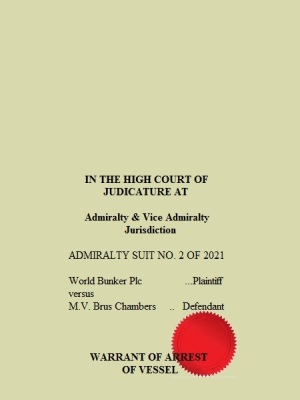
How to
Proceed?
Step-by-Step Guide to Arrest a Ship Anywhere in India
View more
How much
will it Cost?
Professional fees and expenses explained
View more
Who
We Are?
Shipping and Commercial Arbitration specialist
View more
Back to
Home Page
View more
CONTACT
Dr. Shrikant Pareshnath Hathi
Managing Partner,
BRUS CHAMBERS, Advocates & Solicitors,
8, Rajabahadur Mansion, 3rd Floor,
Ambalal Doshi Marg, Fort, Behind BSE,
Mumbai 400001, India
Phone: +91-9769946865
Web: More info
Email: shrikant@bruschambers.com
OR
Ms. Binita Hathi
Partner,
BRUS CHAMBERS, Advocates & Solicitors,
8, Rajabahadur Mansion, 3rd Floor,
Ambalal Doshi Marg, Fort, Behind BSE,
Mumbai 400001, India
Phone: +91-9769946864
Web: More info
Email: binita@bruschambers.com