Arresting a Ship from Odisha High Court
Admiralty Jurisdiction under the Admiralty (Jurisdiction and Settlement of Maritime Claims) Act, 2017
Pursuant to the enactment of the Admiralty (Jurisdiction and Settlement of Maritime Claims) Act, 2017 (hereinafter referred to as the "Act"), the Odisha High Court has been vested with admiralty jurisdiction. Section 4 of the Act explicitly empowers the High Courts designated under the Act, including the Odisha High Court, to entertain admiralty suits and adjudicate upon maritime claims. This jurisdiction extends to granting orders for the arrest of vessels situated within the territorial waters of the State of Odisha, provided that the prerequisites stipulated under the Act and the accompanying procedural rules are duly satisfied.
Geographic and Maritime Significance of Odisha
Odisha is recognized as a principal maritime state, with a substantial coastline stretching approximately 480 kilometers. This coastline commences at the Bahuda Mouth in the southern district of Ganjam and extends northward to Bichitrapur (Talashari) in the district of Balasore. The coastline intersects six significant coastal districts of Odisha, namely:
-
Balasore (80 km)
-
Bhadrak (50 km)
-
Kendrapara (68 km)
-
Jagatsinghpur (67 km)
-
Puri (155 km)
-
Ganjam (60 km)
This coastal region is endowed with favorable natural conditions and strategic port locations, rendering it a critical area for maritime trade and commerce. The varied ecological niches and habitats along this coastline further enhance its maritime and ecological importance.
Ports and Harbors in Odisha
The coastline of Odisha hosts several ports and harbors, both operational and under development, which contribute significantly to maritime trade. These ports include:
-
Astaranga Port
-
Dhamara Port
-
Gopalpur Port
-
Mahanadi Riverine Port
-
Paradip Port
-
Subarnarekha Port
-
Bichitrapur Port
-
Bahabalpur Port
-
Chandipur Port
-
Inchudi Port
-
Chudamani Port
-
Jatadhar Muhan Port
-
Baliharichandi Port
-
Palur Port
-
Bahuda Muhan Port
Each of these ports serves as a vital conduit for the facilitation of international and domestic trade, underlining the strategic importance of Odishas maritime infrastructure.
Filing an Admiralty Suit in Odisha High Court
Legal Framework for Admiralty Claims
An admiralty suit to secure an order of arrest of a vessel under the provisions of the Act can be instituted in the Odisha High Court by any person having a maritime claim. Section 4 of the Act delineates the scope of maritime claims, which include, but are not limited to:
-
Claims related to the ownership or possession of a vessel.
-
Claims concerning mortgages or charges on a vessel.
-
Claims arising out of loss or damage caused by a vessel.
-
Claims for salvage, towage, or pilotage services.
-
Claims for goods, materials, or services provided to a vessel.
-
Claims arising out of collisions or other accidents at sea.
Procedural Requirements
To secure an order for the arrest of a vessel, the claimant must:
-
File a suit in rem against the vessel in the Odisha High Court.
-
Demonstrate a valid maritime claim under Section 4 of the Act.
-
Provide sufficient evidence that the vessel is within the territorial waters of Odisha at the time of filing the suit.
-
Submit an affidavit verifying the claim and the necessity of arresting the vessel to secure the claim.
Issuance of Arrest Warrants
Upon the satisfaction of the Court regarding the prima facie existence of a maritime claim, the Court may issue an order for the arrest of the vessel. Such an order is typically directed to the Sheriff of the concerned jurisdiction or the designated authority empowered to enforce admiralty orders under the rules of the High Court.
Execution of Arrest Orders
The arrest of a vessel involves a series of coordinated actions:
-
Notification to Authorities: The arrest order must be communicated to the Port Authority and the Customs Department to ensure the vessels detention.
-
Physical Arrest: The vessel is physically detained within the territorial waters of Odisha, preventing its departure until further orders from the Court.
-
Posting of Security: The arrested vessels owner may secure its release by furnishing adequate security, such as a bank guarantee, to the satisfaction of the Court.
Strategic Importance of Admiralty Jurisdiction in Odisha
Odishas ports, such as Paradip Port and Dhamara Port, serve as major hubs for the export and import of goods, including coal, iron ore, and agricultural products. The efficient exercise of admiralty jurisdiction by the Odisha High Court ensures the protection of maritime creditors rights, thereby promoting confidence in the states maritime trade ecosystem.
Legal Precedents and Case Law
Indian jurisprudence provides ample guidance on the exercise of admiralty jurisdiction, including the arrest of vessels. Noteworthy precedents include:
-
M.V. Elisabeth v. Harwan Investment & Trading Pvt. Ltd. (1993): This landmark judgment by the Supreme Court of India recognized the jurisdiction of High Courts in admiralty matters, even in the absence of specific statutory provisions.
-
Tag Offshore Ltd. v. M.V. Sam Hawk (2016): This case elaborated on the procedural requirements for vessel arrest and the rights of claimants.
-
The Bold Buccleugh (1851): An English precedent often cited in Indian courts for principles governing maritime liens and claims.
The Odisha High Court, empowered under the Admiralty (Jurisdiction and Settlement of Maritime Claims) Act, 2017, plays a pivotal role in adjudicating maritime claims and enforcing rights through the arrest of vessels. Its jurisdiction, coupled with Odishas strategic coastal infrastructure, underscores its significance in Indias maritime legal landscape. By adhering to the procedural and substantive requirements of admiralty law, the Court ensures the expeditious and equitable resolution of maritime disputes, thereby fostering a robust maritime trade environment in the state.
Arresting a Ship in India



India
Ship Arrest
All about Ship Arrest in India and Admiralty Laws
View more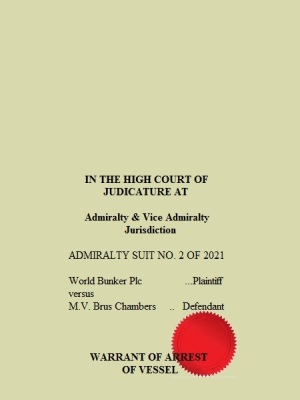
How to
Proceed?
Step-by-Step Guide to Arrest a Ship Anywhere in India
View more
How much
will it Cost?
Professional fees and expenses explained
View more
Who
We Are?
Shipping and Commercial Arbitration specialist
View more
Back to
Home Page
View more
CONTACT
Dr. Shrikant Pareshnath Hathi
Managing Partner,
BRUS CHAMBERS, Advocates & Solicitors,
8, Rajabahadur Mansion, 3rd Floor,
Ambalal Doshi Marg, Fort, Behind BSE,
Mumbai 400001, India
Phone: +91-9769946865
Web: More info
Email: shrikant@bruschambers.com
OR
Ms. Binita Hathi
Partner,
BRUS CHAMBERS, Advocates & Solicitors,
8, Rajabahadur Mansion, 3rd Floor,
Ambalal Doshi Marg, Fort, Behind BSE,
Mumbai 400001, India
Phone: +91-9769946864
Web: More info
Email: binita@bruschambers.com