Arresting a Ship from Telangana High Court
The Admiralty (Jurisdiction and Settlement of Maritime Claims) Act, 2017 (hereinafter referred to as the "Admiralty Act, 2017"), marks a significant evolution in Indian admiralty law by providing a comprehensive framework for the resolution of maritime claims. It consolidates various provisions relating to the arrest of vessels, maritime liens, and the jurisdiction of courts in maritime matters. With the enactment of the Admiralty Act, 2017, the jurisdiction of maritime courts has been significantly expanded, including empowering the High Courts in India with admiralty jurisdiction. In this context, the Telangana High Court, being vested with admiralty jurisdiction under the provisions of the Admiralty Act, 2017, holds the authority to entertain admiralty suits, including the arrest of ships within its territorial jurisdiction.
Admiralty Jurisdiction of Telangana High Court
Section 4 of the Admiralty Act, 2017, grants the High Courts in India exclusive jurisdiction over maritime claims. This section, in particular, extends the admiralty jurisdiction of the High Court to cover suits relating to maritime claims that arise in the territorial waters of India. Therefore, the Telangana High Court, as a court of competent jurisdiction, may entertain suits concerning maritime claims if the vessel subject to the suit is located within the territorial waters of the state of Telangana.
Territorial waters, as defined under the law, extend to a limit of 12 nautical miles from the baseline. When a vessel is found within the territorial jurisdiction of Telangana, the High Court can exercise its admiralty jurisdiction to arrest the vessel, subject to satisfying the necessary legal requirements as outlined in the Admiralty Act, 2017 and relevant procedural rules.
Basis for the Arrest of a Vessel
The arrest of a ship is a drastic yet essential remedy available to a maritime claimant. It is used to secure a maritime claim or ensure that the defendant will appear in court. The Admiralty Act, 2017, provides specific provisions under which the arrest of a vessel may be requested and granted.
Under Section 4 of the Admiralty Act, 2017, a party may apply to the Telangana High Court to arrest a vessel in order to secure a maritime claim. The maritime claim must fall within the categories specified in the Act, such as claims for damages arising out of the operation of the ship, claims for cargo or freight charges, and other maritime claims enumerated in Section 5 of the Admiralty Act, 2017.
Section 6 of the Admiralty Act, 2017, further enumerates the grounds for arrest, which include:
-
Claims relating to ownership or possession of a vessel: Claims for disputes arising out of the ownership, possession, or the control of a vessel.
-
Claims for damage caused by the ship: Claims arising from the ships operation or activities, including accidents, collisions, or damage to port facilities.
-
Claims related to the supply of goods and services: Claims by those who have provided goods, materials, or services necessary for the operation of the ship.
-
Crew wages and employment-related claims: Claims arising from contractual agreements related to the employment of crew members aboard the vessel.
-
Maritime lien claims: Claims secured by maritime liens, including those for salvage or the preservation of the vessel.
Thus, any maritime claim falling within these categories, if found within the jurisdiction of Telangana High Court, can be the basis for an application for the arrest of the vessel.
Procedural Aspects of Ship Arrest in the Telangana High Court
The procedure for arresting a ship in the Telangana High Court follows the guidelines set out in the Admiralty Act, 2017, along with the Admiralty Rules of the High Court, which provide detailed procedures for filing suits, obtaining arrest orders, and executing such orders. The process involves the following steps:
-
Filing the Admiralty Suit: The claimant must file a suit under the provisions of the Admiralty Act, 2017. The suit must be supported by evidence demonstrating the existence of a maritime claim. This claim should align with the criteria set forth in the Act. The Telangana High Court, upon receiving the suit, will examine whether it has jurisdiction to hear the matter, based on the location of the vessel in its territorial waters.
-
Application for Arrest: The claimant must submit a formal application for the arrest of the vessel along with the suit. This application must specify the nature of the maritime claim, the grounds for arrest, and the details of the vessel in question. The application must also provide an undertaking, usually in the form of a bank guarantee, which assures the payment of any potential damages if the arrest is deemed wrongful.
-
Courts Review of the Application: Upon receiving the application, the Telangana High Court will assess whether the maritime claim is valid and whether the vessel falls within its jurisdiction. The court will also verify whether the arrest of the ship is warranted based on the grounds set forth in the Admiralty Act, 2017. If the court is satisfied with the application and supporting documentation, it may issue an order for the arrest of the vessel.
-
Issuance of the Warrant of Arrest: If the court finds the application to be in order, it will issue a warrant of arrest. The arrest warrant directs the Sheriff or Marshal of the court to take physical control of the vessel. This warrant is typically executed with the assistance of local authorities, including the port authorities or law enforcement agencies, who may be tasked with ensuring that the vessel is arrested and detained at the designated location.
-
Execution of Arrest: Upon the issuance of the arrest warrant, the ship is physically seized by the Sheriff or Marshal. The vessel is then detained until the maritime claim is resolved or security for the claim is provided by the defendant. During this period of detention, the vessel cannot be moved or sold unless the arrest is lifted by the court, typically upon the furnishing of security.
-
Security for Release of the Vessel: If the defendant wishes to have the vessel released from arrest, they may apply to the court for the release upon providing adequate security. The security typically involves the deposit of a bank guarantee or a surety in a sum determined by the court, which will cover the value of the claim and any potential damages. If the security is accepted, the vessel may be released from arrest, subject to the conditions set by the court.
-
Judicial Review: If the defendant challenges the arrest or seeks the lifting of the arrest, the Telangana High Court will review the matter. The defendant may argue that the claim is not valid, or the arrest is wrongful, and request the court to discharge the arrest. The court will then determine whether the arrest was justified, and whether the conditions for lifting the arrest have been met.
Grounds for Discharge of the Arrest
The arrest of a vessel is not a final remedy, and the defendant has the right to challenge it. Under the Admiralty Act, 2017, there are several grounds on which the arrest may be discharged or stayed:
-
Lack of Jurisdiction: If the Telangana High Court determines that it does not have jurisdiction over the matter or the vessel is not within its territorial waters, it may discharge the arrest.
-
Wrongful Arrest: If the defendant can demonstrate that the arrest was wrongful, for instance, if the maritime claim does not meet the legal requirements for arrest, the court may discharge the arrest.
-
Provision of Security: The arrest may be discharged if the defendant furnishes adequate security to cover the claim and any potential damages resulting from the wrongful arrest.
-
Settlements or Negotiations: If the parties reach a settlement or agree to an out-of-court resolution, the defendant may seek to have the arrest lifted upon submission of the appropriate settlement agreement and security.
The Role of the Telangana High Court in Maritime Disputes
The Telangana High Court, exercising admiralty jurisdiction, plays a crucial role in ensuring that maritime claims are adjudicated in a manner that is fair, efficient, and consistent with international maritime law principles. The court ensures that the arrest of a vessel is carried out in accordance with the provisions of the Admiralty Act, 2017, and protects the rights of both claimants and defendants.
In doing so, the court serves not only as a forum for resolving maritime disputes but also as an authority for safeguarding the integrity of the shipping industry in India. The court's ability to grant orders for the arrest of ships ensures that maritime claims are not only recognized but also enforceable, thus providing a legal mechanism to uphold the interests of parties involved in maritime commerce.
The Telangana High Court, empowered by the Admiralty (Jurisdiction and Settlement of Maritime Claims) Act, 2017, has the authority to hear maritime claims and order the arrest of vessels found within its territorial waters. The process of arrest is governed by clear legal provisions, which ensure that the arrest is executed lawfully, with safeguards in place to protect the interests of both claimants and defendants. Through its effective exercise of admiralty jurisdiction, the Telangana High Court plays an essential role in the enforcement of maritime claims and the resolution of maritime disputes in India.
Arresting a Ship in India

India
Ship Arrest
All about Ship Arrest in India and Admiralty Laws
View more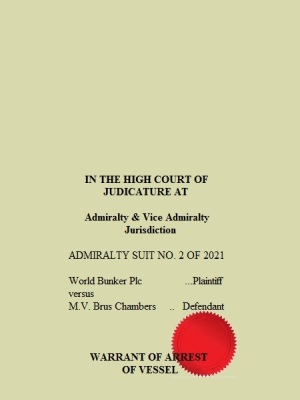
How to
Proceed?
Step-by-Step Guide to Arrest a Ship Anywhere in India
View more
How much
will it Cost?
Professional fees and expenses explained
View more
Who
We Are?
Shipping and Commercial Arbitration specialist
View more
Back to
Home Page
View more
CONTACT
Dr. Shrikant Pareshnath Hathi
Managing Partner,
BRUS CHAMBERS, Advocates & Solicitors,
8, Rajabahadur Mansion, 3rd Floor,
Ambalal Doshi Marg, Fort, Behind BSE,
Mumbai 400001, India
Phone: +91-9769946865
Web: More info
Email: shrikant@bruschambers.com
OR
Ms. Binita Hathi
Partner,
BRUS CHAMBERS, Advocates & Solicitors,
8, Rajabahadur Mansion, 3rd Floor,
Ambalal Doshi Marg, Fort, Behind BSE,
Mumbai 400001, India
Phone: +91-9769946864
Web: More info
Email: binita@bruschambers.com